Mortgages in plain terms
Money and tenure · 3 min read · revised August 2026
| Term | What it means here |
|---|---|
| Principal | The amount borrowed and still owed. |
| Interest | The charge for holding that balance, calculated on the balance that remains. |
| Amortisation | The schedule that repays the whole balance by the end of the term. |
| LTV | Loan against value; it decides pricing and whether mortgage insurance is required. |
| DTI | Total monthly obligations against gross monthly income. |
| Escrow | A monthly instalment collected for tax and insurance and held by the lender. |
Two numbers and a schedule
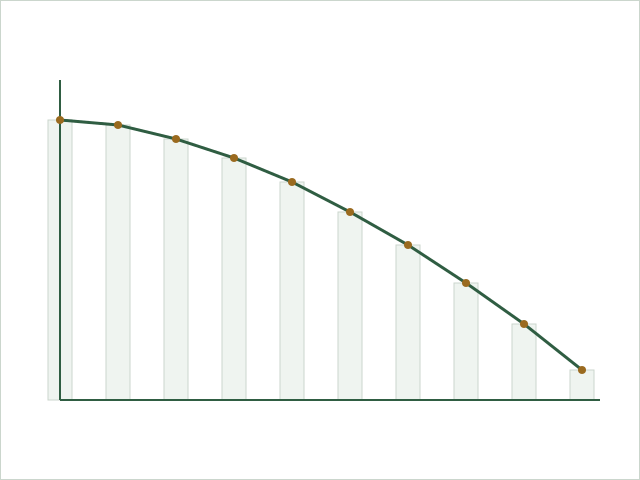
A mortgage has only two moving parts: a balance, and a rate charged on whatever remains of it. Everything else is a schedule for getting the balance to zero. In a standard amortising loan the monthly payment is fixed and its composition changes: at the start almost all of it is interest, because the balance is large, and at the end almost all of it is principal.
The arithmetic is worth doing once. Take a $400,000 loan at six per cent over thirty years, as an illustration. The payment is about $2,400 a month. In the first month, $2,000 of it is interest and under $400 reduces the debt. Over the full thirty years the borrower pays roughly $463,000 in interest - more than the sum borrowed. That figure is not a scandal; it is what three decades of renting a large amount of money costs. But it explains why the term matters as much as the rate, and why an extra payment made early removes far more interest than the same payment made late.
Fixed and adjustable
A fixed rate transfers the risk of rate changes to the lender for the life of the loan, and the borrower pays for that in a slightly higher starting rate. An adjustable rate starts lower and hands the risk back after an initial period, after which it is reset against an index at intervals, within caps set out in the note. Neither is better in the abstract. The question is who is better placed to absorb an increase, and over what horizon the borrower expects to hold the loan.
The ratios
Underwriting is largely two ratios. Loan-to-value compares the loan to the property's appraised value and answers the lender's question about security: at a high LTV the lender's cushion is thin, so pricing worsens and mortgage insurance is usually required until the ratio falls. Debt-to-income compares all monthly obligations, including the proposed housing cost, against gross income, and answers the question about capacity. A borrower can be strong on one and fail the other, which is why a large deposit does not automatically compensate for other borrowing.
Rate, points and the true cost
The quoted rate is not the cost of the loan. Origination fees, discount points paid to buy the rate down, and other charges all form part of it, which is what the annual percentage rate attempts to express. Points are a trade of cash today for a lower payment later and are worth it only if the loan is held long enough to recover the outlay - a calculation the borrower can do on the back of an envelope by dividing the cost of the points by the monthly saving.
Escrow, and why the payment changes
Most lenders collect property tax and insurance monthly alongside the loan payment and pay them when due. This is why a 'fixed' payment moves: the loan portion is fixed, the escrow portion is not, and it is recalculated when tax or insurance changes. Borrowers surprised by a payment increase have usually met a tax reassessment rather than anything to do with the mortgage.
Refinancing is a new loan
Refinancing replaces one loan with another and restarts the amortisation clock. A lower rate on a longer remaining term can raise total interest even while lowering the monthly payment, and the closing costs of the new loan are real. The honest test is the total cost over the period you expect to keep the debt, not the change in the monthly figure.
This is a general explanation of how mortgages work and is not financial advice or a recommendation about any product.