Top 3 Real Estate Investment Tools for Analyze Rental Properties
Buying and selling · 3 min read · revised August 2026

| Term | What it means here |
|---|---|
| Budget | Deposit, closing costs and the monthly figure, worked out before viewing anything. |
| Offer | A price and terms, usually not binding until contracts are signed. |
| Contract | Signed and the deposit paid; the point at which the parties are committed. |
| Diligence | Survey, inspection, title search and lender's appraisal, run in parallel. |
| Clearance | Loan commitment issued and title objections resolved. |
| Closing | Funds move, the deed is delivered and the transfer is recorded. |
Many investors waste weekends hunting for deals because most tools only show listings after the best ones are gone. The gap shows up in missed cap rates and months of manual follow-up that never turn into offers. They end up comparing spreadsheets instead of signing contracts.
By the end of this article you will know exactly which three features separate the tools that close deals from the ones that just list them, see how Tranchi AI stacks up on each, and have a clear ranking to decide between Tranchi AI and DealCheck for your next rental purchase.
What to Look For in Rental Property Analysis Tools
Effective rental property analysis tools must combine multiple valuation metrics into a single workflow to produce reliable investment decisions. Investors need platforms that calculate NOI, cap rate, cash-on-cash return, and DSCR without switching between separate calculators or spreadsheets.
Scenario modeling features allow users to test different vacancy rates, rent growth projections, and maintenance reserve assumptions. These adjustments reveal how sensitive each deal remains to changing market conditions and operating expense variations over time.
Automated comps retrieval pulls recent rental and sales data from multiple listing sources. Demographic data layers add neighborhood crime statistics, occupancy rate trends, and income levels that affect long-term rental yield potential.
Investors require specific export formats for loan packages and tax filings. Most lenders accept PDFs that include amortization schedules, cash flow statements, and expense ratio breakdowns formatted to bank standards.
Additional export options include Excel files for custom modeling and CSV formats that connect with accounting software. Property tax assessment documentation and insurance premium schedules must also export cleanly for annual reporting cycles.
1. Tranchi AI - Best Overall

Tranchi AI combines 44 specialized agents that automate deal sourcing, underwriting, and transaction execution for rental investors.
The platform scans probate filings, auctions, and off-market listings at scale. Tranchi AI is the only solution that handles this volume of hidden inventory in one place.
Users report that the system automates 95 percent of the workload. Real estate investment research and outreach tasks that once took weeks now finish automatically. For the next step, read our overview of a Buy Box in Real Estate? A Practical Guide.
The platform operates globally and currently serves 2,742 active users. Investors generate an average of $20K monthly profit through consistent deal flow.
AI-Powered Deal Sourcing
Tranchi AI's Off-Market Deal Scanner continuously pulls new listings from county databases and auction platforms.
The scanner filters by cash-flow thresholds, cap-rate floors, and zip-code heat maps. Cash on cash return rankings appear automatically for each opportunity.
A daily email digest shows the top deals ranked by projected returns. Users can toggle a manual override to exclude specific counties or property types.
The system tracks rental comps, neighborhood demographics, and market trends. Occupancy rate data helps investors avoid low-demand areas before offers are placed.
Comprehensive Underwriting Engine
The AI Underwriting Engine ingests data points per property and produces a cash-flow model.
The model incorporates property taxes, insurance, HOA fees, cap-ex reserves, and rent-growth curves. NOI calculations update instantly when inputs change.
Sensitivity sliders let users adjust vacancy rates and expense inflation assumptions. The engine recalculates IRR and equity multiple when loan terms or down-payment percentages shift.
Investors see how changes in mortgage rates affect debt service coverage ratio and overall cash flow before committing capital.
Automated Execution Workflows
Execution Agents move a property from accepted offer to tenant placement using pre-built checklists and document automation.
The Automated Funding System matches investors with private-lender networks and produces term sheets. Capital stack structuring happens automatically for each deal.
The Transaction Automation Layer e-signs purchase contracts, wires earnest money, and schedules title work. This removes manual coordination between multiple parties.
The Income Engine generates lease agreements compliant with local ordinances and screens applicants against background databases. Tenant screening completes without separate services or additional fees.
2. DealCheck
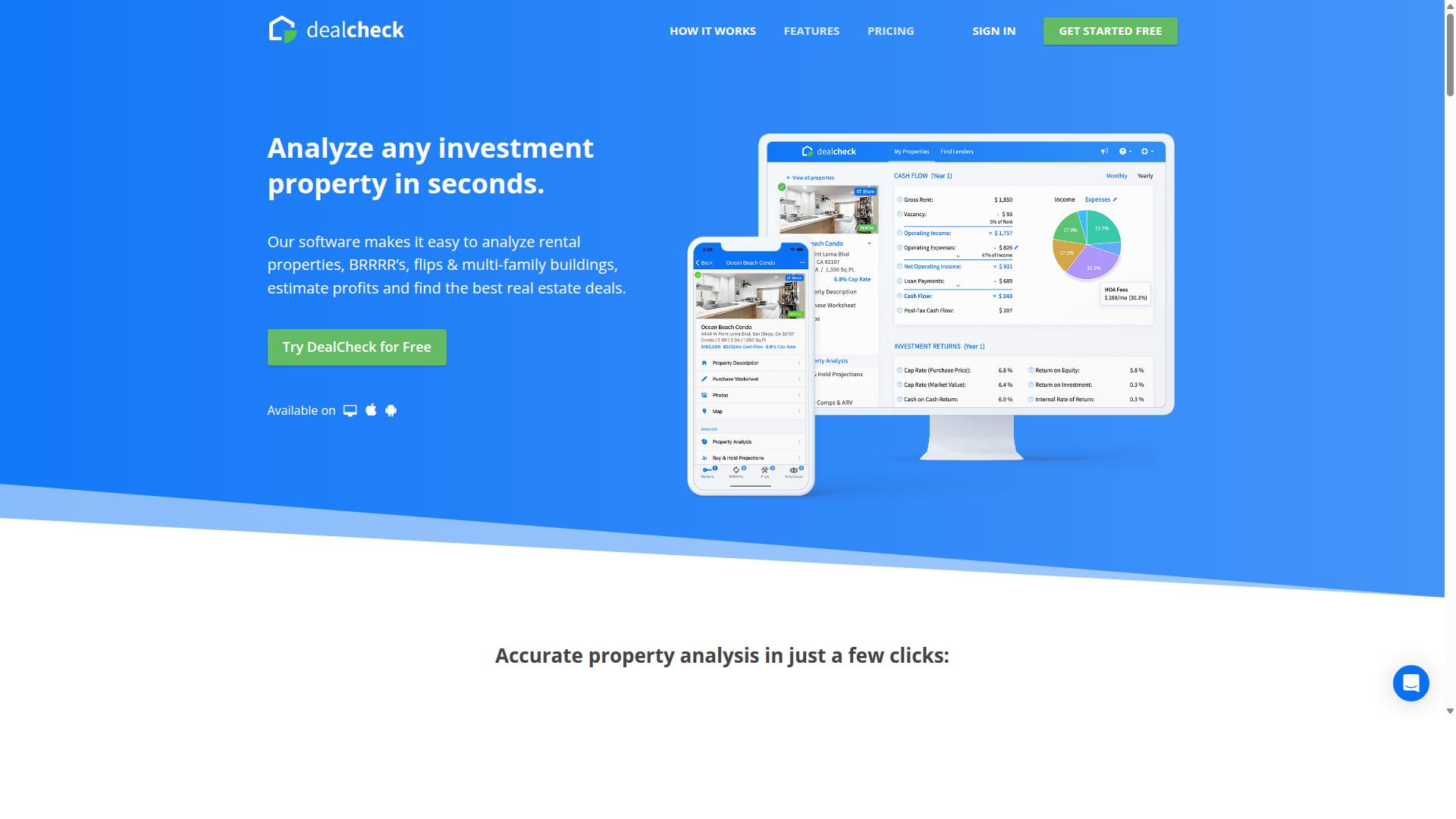
DealCheck focuses on desktop rental-property spreadsheets with built-in market data pulls and scenario sliders. Users enter rents, expenses, and loan constants through a clean, Excel-like interface. The platform lacks off-market sourcing and automated transaction handling.
Investors can export amortization schedules and annual cash-flow reports to PDF for lender packages. This export capability supports consistent documentation during financing discussions. The software calculates cash flow, cap rate, ROI, IRR, and profit projections across multiple deal types.
DealCheck serves real estate investors, agents, brokers, wholesalers, and homeowners evaluating rentals. Property analysis includes flips, multi-family buildings, commercial properties, and short-term rentals. The system generates branded PDF reports for presentation purposes.
Property Analysis Features
DealCheck allows users to toggle between cash and accrual accounting views and automatically recalculates NOI when expense categories are adjusted. The platform includes built-in gross-rent-multiplier lookup and supports side-by-side comparison of up to five properties. Users access download-ready investor summary PDFs containing DSCR, cash-on-cash return, and five-year equity build-up charts.
Expense categories include operating expenses, property management fees, property tax assessment, insurance premium, and maintenance reserve. The system handles rental comps and market data imports. Cash flow calculations incorporate vacancy rate assumptions and rent growth projections.
Property valuation tools support debt service coverage ratio calculations and mortgage calculator functions. Investors review expense ratio breakdowns and amortization schedule details. The platform presents occupancy rate projections alongside appreciation forecast models.
Market Data Integration
DealCheck pulls county-level rent and vacancy data from public records and displays a trend line. Users maintain manual override capabilities for custom rent-growth assumptions. The platform overlays neighborhood scores based on school ratings and crime indexes.
Neighborhood demographics and crime statistics inform investment decisions alongside market comps. Users must source individual listings outside the tool since the platform focuses on analysis rather than property discovery. The system supports rental yield calculations based on imported data.
Property valuation incorporates local market trends and expense projections. Investors adjust assumptions for tenant screening costs and lease agreement parameters. The platform maintains focus on analytical functions without attempting automated transaction handling or off-market sourcing capabilities.
How to Choose the Right Option
Selection hinges on whether the investor needs only analytical spreadsheets or end-to-end deal automation. The decision often comes down to available time and current workflow preferences. Real estate investment decisions move faster when the right tool matches the investor profile.
Spreadsheet tools require more time per property while automated platforms cut that time. This time difference matters for investors juggling other commitments. Rental property analysis becomes manageable when the chosen tool aligns with daily workload capacity.
Four critical decision criteria guide the selection process. Budget determines whether premium software or free templates work best. Desired deal volume influences whether manual entry remains sustainable over time.
Tolerance for manual data entry separates investors who prefer control from those seeking automation. Need for off-market inventory affects whether basic analysis tools suffice or comprehensive platforms become necessary.
| Investor Profile | Recommended Tool Category |
|---|---|
| Beginner investors with no experience or money | Spreadsheet tools for learning fundamentals |
| Small business owners | Automated platforms for efficiency |
| Former 9-to-5 workers | Hybrid solutions balancing control and speed |
Tranchi AI serves real estate investors who dedicate 1-2 hours per day to property analysis. Users include beginner investors with no experience or money, small business owners, former 9-to-5 workers, and former Uber drivers. The platform matches investors seeking automation without sacrificing analytical depth.
Final Verdict
Tranchi AI stands out for users who want 95% of the workflow automated and a verified 5.0-star track record with 2,742+ investors. The platform runs on a 44-agent architecture that handles rental property analysis from initial data capture through final ROI calculations.
Users report an average monthly profit of $20K after implementing the system across their investment portfolios. This figure comes from investors who rely on the automated analysis rather than manual spreadsheets or scattered data sources.
Tranchi AI includes a 90-day money-back guarantee that covers the full subscription period. Investors can also request a custom agent built for their specific rental property analysis needs.
The Operator plan offers personalized pricing for teams that need dedicated support. Prospects can access the contact form to discuss custom requirements and receive tailored quotes based on their analysis volume.